

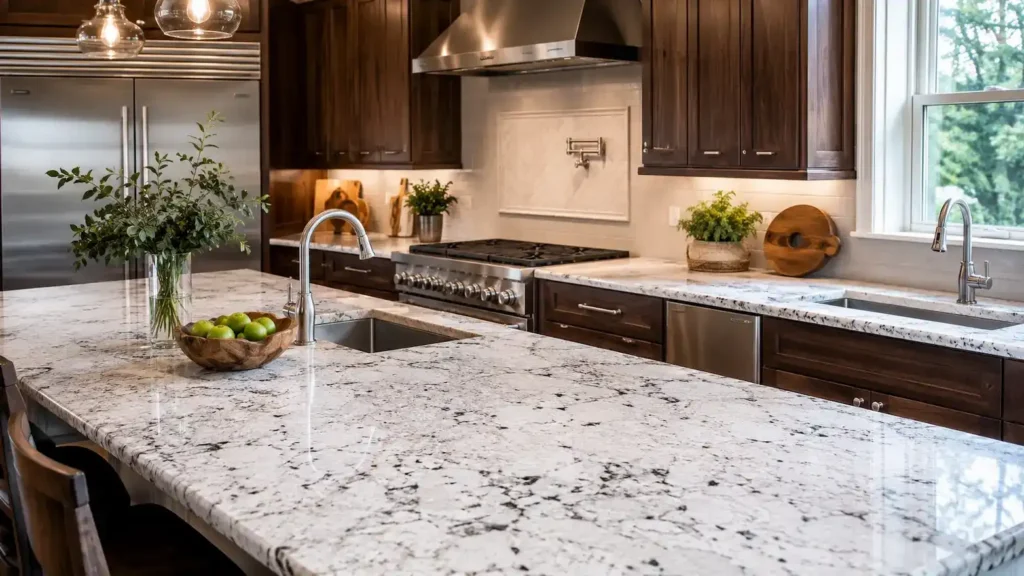
Somebody brings up white granite countertops in almost every kitchen consult we sit through. The reason is always some version of the same thing: a kitchen that photographs dark, feels heavy, and needs light without going flat and lifeless like laminate.
Here’s the part that gets skipped. Granite is rock. It has pores, veins, a mineral makeup that came from somewhere specific underground, and none of that disappears once it’s cut into a slab and dropped into a kitchen. Buy white granite countertops without understanding what that rock actually does over ten years and the regret shows up right around year two, usually as a ring stain nobody can explain.
At Lone Star Remodeling Dallas, we have this conversation with homeowners before a single slab gets picked. The stone that looks perfect in a showroom isn’t always the stone that survives a family’s actual cooking habits.
What Actually Makes White Granite Countertops Different
Heat and pressure build granite underground over unthinkable stretches of time. That’s where the flecks come from, the veining, the reason no two slabs match exactly. White varieties lean on quartz and feldspar for their brightness, with darker minerals like mica cutting through as contrast.
Two slabs can share the same trade name and still look nothing alike. Depends entirely on which quarry cut them. This is why picking granite off a two-inch sample chip is a gamble, and picking it off the actual slab at a stone yard isn’t.
We’ve had more than one client fall for a swatch, order the slab, and stand in their new kitchen wondering why it doesn’t match what they picked out. Stone doesn’t repeat itself. A photo of a sample never tells the whole story, not the way standing in front of the real thing does.
Quartz and laminate can’t fake what granite does naturally. That’s the tradeoff. White granite countertops bring texture no factory process replicates, but they also bring unpredictability. Somebody chasing a perfectly matched, uniform kitchen might be happier with quartz. That’s just true, and it’s worth saying plainly instead of dancing around it during a sales pitch.
Durability, Heat and the Wear of Actual Daily Life
Granite takes heat. Set a hot pan straight off the stove onto a sealed slab and nothing happens. Try that on laminate and you’ll see the damage within a week. White granite countertops handle that kind of daily abuse better than almost any surface short of solid steel.
Countertop durability comes down to sealing, full stop. An unsealed slab drinks up oil, wine, lemon juice, anything acidic that sits too long, and staining follows. Seal it properly and that same spill wipes off clean. The stone hasn’t changed. The maintenance has.
Knives dull faster cutting straight onto granite, and yes it can leave faint marks after years of abuse. Doesn’t matter. Every kitchen designer we know still tells clients to use a cutting board anyway, because the knives lose that fight before the counter does.
Chips happen at corners, mostly on thin slabs or fussy beveled edges. A thicker slab profile shrugs off that kind of bump. Simple as that, and worth asking about before a fabricator cuts anything.
Sealing and What Long-Term Care Actually Looks Like
Porosity varies by quarry, sometimes by the individual slab sitting in the yard. Denser white granite might go two or three years between sealing. A more porous cut needs attention every single year without fail. There’s no shortcut around knowing which type sits in your kitchen.
There’s a homeowner test worth doing. Drop water on the counter. Watch it. Beads up and sits there, seal’s fine. Soaks in within a couple of minutes, time to reseal. No lab, no contractor visit required.
Soap and water handle ninety percent of cleaning. Skip the vinegar, skip the lemon-based sprays people love for “natural” cleaning, because both slowly eat into the sealer and dull it over months of use.
White granite countertops that get resealed on schedule, with spills wiped up before they sit overnight, still look close to new past the decade mark. That’s not marketing. That’s just what consistent care does to stone, year after year, without much drama involved.
Cabinets, Flooring, and the Lighting Nobody Thinks About
Dark cabinets make white granite pop. The contrast does the work, pulling the veining forward instead of letting it disappear into a busy background. Light cabinets can still pair well, but now undertones have to actually agree with each other.
Warm gold flecks against cool gray cabinets clash, plain and simple. Cooler gray veining sits easier next to cool-toned cabinetry. Bring an actual cabinet door sample to the stone yard. Guessing from memory almost never works out.
Flooring plays the same game. Warm wood tones pull naturally toward granite carrying similar warm flecks. Cooler tile or stone flooring wants a grayer granite to match it.
Lighting changes everything, and this is the part people skip entirely. Daylight pulls out color variation that warm bulbs completely flatten. A slab picked under fluorescent showroom lights can read totally different once it’s sitting under your kitchen’s actual windows, sometimes different enough that a homeowner second-guesses their own choice for weeks after installation.
Seams, Edges, and the Support Work Underneath
Slabs come in fixed sizes. A big island or a long counter run usually needs a seam somewhere, and the good spots are near a sink or appliance, not dead center where every guest will see it. Planning white granite countertops around a kitchen’s actual footprint avoids that problem entirely.
Edge choice matters for more than looks. A simple eased edge resists chipping. An ornate bullnose or beveled edge looks custom but chips more easily at the corners over time. Both are valid choices. Just know the tradeoff going in.
Overhangs need support, and this gets missed constantly. An island built for stools needs corbels or a steel bracket underneath, or the slab cracks under sustained weight eventually. That decision belongs in the cabinet design phase, not as an afterthought once the granite’s already ordered.
Handling granite wrong during installation cracks slabs that would’ve lasted decades otherwise. This is not a job for enthusiasm alone. Professional installation matters here more than almost any other kitchen material, and it’s not a place to cut corners on labor cost.
White Granite Countertops Against Quartz and Marble
Quartz wins on predictability. It’s engineered, not quarried, so every slab looks like the last one. No sealing required either, which appeals to anyone who wants one less maintenance task on their list.
Marble looks similar to some white granite countertops at a glance, veined and bright, but it behaves nothing alike once real cooking starts. Softer stone, more porous, etches from lemon juice practically on contact. Marble belongs somewhere calmer than a working prep zone.
Granite sits in the middle, and that middle spot is exactly its appeal. More character than quartz, tougher against heat and acid than marble. Homeowners who want real stone without marble’s fragility keep landing back on granite for a reason.
Which one wins depends on how a family actually cooks, not which slab photographs best on a design blog. Heavy acid, heavy heat, daily cooking, granite or quartz. Lighter use, more forgiving lifestyle, marble’s looks might win out. There’s no universally correct answer here, only the one that fits how a specific kitchen gets used.
What Actually Drives the Price of Granite Kitchen Counters
Rarity drives price more than anything else. Common white granite runs cheaper simply because it’s not hard to find. Exotic patterns cost more because quarrying them is harder and supply is tighter, and that gap between common and rare can swing a budget significantly.
Edge profiles and cutouts add up fast. A basic layout with standard sink and cooktop cutouts costs less than waterfall edges or several custom cutouts for specialty appliances.
Slab size against kitchen layout matters too, more than most homeowners think about upfront. Standard dimensions waste less material. Odd cuts and pieced-together slabs waste more, and that waste shows up directly on the invoice, which is exactly why kitchen surface planning belongs in the design phase, not an afterthought.
The real number for white granite countertops depends on the stone picked, the kitchen’s actual dimensions, and fabrication details that only surface once a template gets cut. Treat any early number as a range, not a promise.
The Mistakes That Show Up After Installation, Not Before
Choosing granite from a tiny chip is mistake number one. Granite shifts across a single slab more than people expect, and a chip the size of a coaster tells you almost nothing about the full pattern.
Skipping the sealing conversation is mistake number two. Granite isn’t maintenance-free just because it’s stone. White granite countertops that never get sealed properly stain, full stop, no exceptions.
Underestimating overhang support is the quiet one. Nobody notices until a hairline crack shows up under a seating overhang months later, and by then it costs real money to fix instead of a quick conversation during design. It’s the kind of mistake that looks like bad luck but is really just a missed planning step.
Picking under showroom lighting rounds out the list. That same slab under your kitchen’s actual daylight can look like a different stone entirely.
Layout Decisions That Shape How the Kitchen Surface Works
A stove-side prep zone needs durability first, looks second. A quiet coffee corner or bar counter has more room to prioritize appearance, since it’s not absorbing daily abuse the same way white granite countertops do near an active cooktop.
Where seams and cutouts land depends on where the sink, cooktop, and prep space actually sit. Good kitchen surface planning maps that out before slab dimensions get locked in, which cuts waste and avoids an awkward seam nobody wanted.
Storage gets forgotten in the excitement of picking stone. Counter space for small appliances, coffee gear, baking supplies, all of it needs mapping before dimensions get finalized. A gorgeous slab with zero usable workspace misses the entire point of a kitchen.
None of this happens in isolation. Countertop, cabinets, lighting, they’re one decision wearing three different names, and treating them that way produces a kitchen that works as well as it photographs, year after year, not just on move-in day.
Deciding If White Granite Countertops Belong in Your Kitchen
White granite countertops fit a household that wants natural texture and real durability, and doesn’t mind resealing every year or two as routine upkeep. They fit poorly for someone chasing zero maintenance or a flawless, machine-made uniform look, and there’s no shame in admitting that’s a real preference plenty of homeowners have.
See the actual slab under your kitchen’s real lighting. Match undertones against cabinet and flooring samples in person. Confirm overhang support before the layout gets locked. All of this belongs early, not as damage control later.
At Lone Star Remodeling Dallas we walk through slab selection and layout together, weighing a specific white granite countertops option against your cabinets, your lighting, your actual daily habits. Homeowners wanting that kind of direct comparison can explore our kitchen remodeling services directly.
A countertop touches nearly every other decision in a kitchen, from cabinet tone to daily workflow. At Lone Star Remodeling Dallas, we can help weigh white granite countertops against the alternatives. Ready to see how different stone actually looks in your kitchen? Compare countertop options before locking in your design.
FAQ
Do white granite countertops stain easily?
Only if the sealer’s gone. Properly sealed granite resists oil and acid; unsealed or poorly maintained slabs soak up stains fast.
How often do granite kitchen counters need sealing?
Anywhere from yearly to every few years, depending on the stone’s porosity. A simple water test tells you where yours stands.
Is white granite more durable than marble?
Yes, generally. Granite handles heat, scratches, and acid better than marble, though both need routine care as natural stone.
Can I cut directly on a granite countertop?
You can, but knives dull faster and faint marks can show up over time. A cutting board protects both surfaces.
What should I check before finalizing a countertop choice?
View the actual slab under real kitchen light, match undertones to cabinets and floors, and confirm overhang support early.