

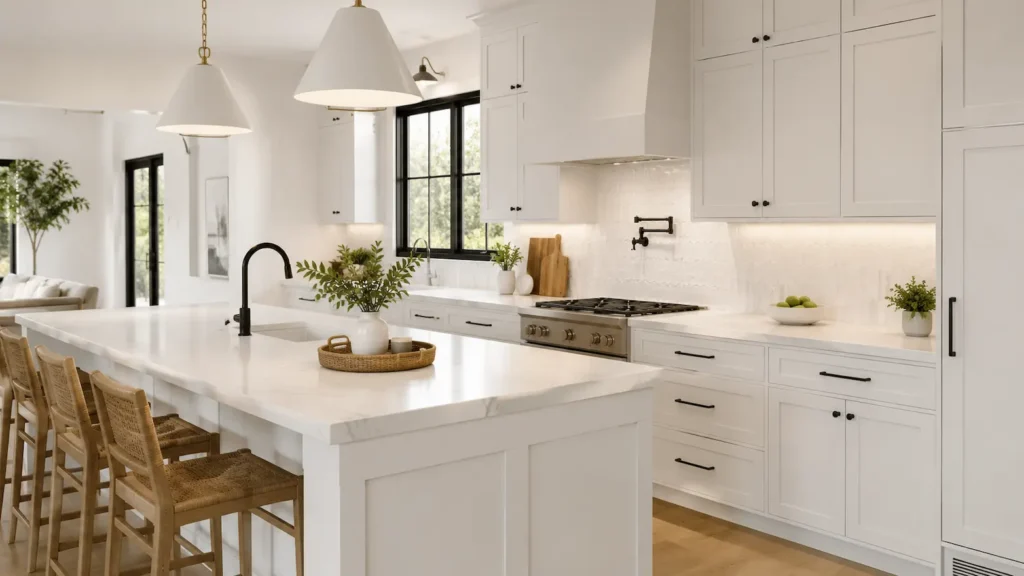
Two kitchens, both painted the same shade of white. One feels like the brightest room in the house. The other feels like a hospital hallway. Paint color rarely explains that gap. Undertone does, texture does, and a handful of contrast decisions most people never think to make on purpose.
Can an all white kitchen actually feel warm? We get that question constantly. Yes, but only if someone plans the layering before cabinets get ordered and grout gets picked. Skip that step and a kitchen that looked crisp on a mood board comes out flat and clinical once it’s actually sitting in a house, no matter how expensive the finishes were.
Lone Star Remodeling Dallas has this conversation early with homeowners, before a single finish gets locked in. Five or six small decisions usually separate a warm result from a cold one. None of them cost extra once they’re built in from the start.
What Actually Makes an All White Kitchen Feel Warm
White isn’t a single color. It’s a whole family of them. Cream leans yellow. Cool white leans blue or gray. True white sits somewhere neutral between the two. Build a kitchen entirely from one undertone and it reads flat, almost sterile. Mix undertones on purpose and the same palette suddenly has depth.
Light changes everything here, more than people expect walking in. A north-facing kitchen with limited daylight turns cool whites gray and lifeless. That exact same white in a south-facing room full of afternoon sun looks crisp instead. Watch how light actually moves through a specific kitchen before locking in an undertone, at different times of day if possible. A sample chip under showroom lighting tells you almost nothing useful about how it will actually behave at home.
We walked into a finished kitchen once where every surface was technically white and the whole room still felt wrong. Three different whites, three different undertones, all fighting each other instead of working together. Subtle on paper. Impossible to miss once it’s built.
Texture does the heavy lifting that color alone can’t. Wood, woven baskets, matte surfaces, all of it softens a room that would otherwise read as one flat, uniform plane from every angle.
Layering Whites: Why Undertones Matter So Much
Cabinets, walls, and countertops almost never share the exact same white in an all white kitchen that actually works. A slightly warmer cabinet against a cooler countertop gives the eye just enough separation to register depth instead of one continuous surface.
Test undertones the right way. Paint a large sample directly on the wall, not a swatch card, and look at it morning, noon, and evening. White shifts dramatically as light changes throughout the day, far more than bolder colors ever do.
Stone veining carries undertone too, even in a mostly white slab. Warm gold-gray shows up in some marbles and quartzites. Others run cooler, more blue-gray. Match that veining to cabinet color instead of choosing each piece independently, or the kitchen ends up feeling unplanned.
The ceiling gets forgotten constantly. Paint it the same stark white as the cabinets without thinking about how light bounces off it, and it can wash out every warmer element in the room.
Texture and Material Choices That Add Warmth
Wood brings warmth that white simply cannot manufacture on its own. A wood island. Open shelving in a warm stain. Wide plank flooring against white cabinetry. Any of these gives the eye somewhere to land besides flat, uniform color.
Woven and natural fiber pieces work at a smaller scale but do real work. A rattan pendant. A jute rug underfoot. Wicker baskets holding open storage. Small touches, real texture, and none of it competes with the white palette.
Matte beats glossy for warmth almost every time. A matte cabinet absorbs light instead of throwing it back sharply, which softens the whole room compared to high gloss, which can read almost clinical under bright kitchen lighting.
Stone and tile with real movement, veining, texture, some visible personality, add warmth a flat uniform surface never will. A slab with character does more work in an all white kitchen than a perfectly consistent, characterless one ever could, and that difference shows up the moment natural light hits it during the day.
Contrast Elements That Stop White From Flattening Out
Black or dark bronze hardware against white cabinetry shows up in nearly every successful all white kitchen we’ve built, and for good reason. It gives the eye somewhere to rest and breaks up what would otherwise be an unbroken field of white.
A dark island inside an otherwise pale all white kitchen anchors the whole room. This doesn’t undercut the concept. It reinforces it, since the contrast makes the surrounding white read as intentional rather than default.
Black-framed windows do similar work from a natural light source itself. That contrast draws the eye outward and keeps a bright kitchen from feeling like it’s floating in undefined white space.
Open shelving holding colorful dishware, cookbooks, plants, introduces contrast without touching a single painted surface. A homeowner can swap accent colors seasonally without repainting anything or reordering cabinets.
Lighting Choices Specific to White Kitchens
White throws light back harder than darker finishes do, so lighting temperature matters enormously here. Warm bulbs, somewhere around 2700 to 3000 Kelvin, keep an all white kitchen feeling inviting rather than clinical once the sun goes down and the fixtures become the only light source in the room.
Under-cabinet lighting pulls double duty. It lights the actual workspace and highlights texture in stone or tile that flat overhead light tends to flatten out entirely. Skip it and a kitchen loses the depth its texture and veining were supposed to provide in the first place.
Pendants over an island solve two problems at once. A warm brass or matte black fixture against white cabinetry adds contrast while handling the practical need for task lighting over a prep surface.
Natural light needs management too. Sheer treatments instead of heavy drapes keep daylight moving through the room without harsh glare, holding onto warmth without sacrificing the brightness that draws people to this style to begin with.
Hardware and Fixtures That Add Depth
Hardware finish shifts an all white kitchen’s whole temperature more than its size or shape ever could. Warm brass or brushed gold pulls a room toward cozy. Matte black or brushed nickel pulls it toward crisp and modern instead.
Faucet finish usually coordinates with cabinet hardware, though an intentional clash, brass against black pulls, can work fine as a deliberate choice rather than an oversight. The key word is deliberate.
Pull style matters beyond finish alone. A substantial, slightly oversized pull reads warmer than a thin minimal bar, even in the identical finish, since proportion affects perceived warmth almost as much as material does.
Appliance finish rounds this out. Stainless steel reads cool and utilitarian against white cabinetry. Matte black or panel-ready appliances blended into the cabinetry keep the warmth going instead of interrupting it.
Durability Realities of an All White Kitchen
White shows certain kinds of wear more visibly than darker finishes do, and that matters practically as much as it matters visually. Matte surfaces hide fingerprints and smudges far better than glossy white, worth remembering near handles, faucets, and other high-touch spots that get used dozens of times a day.
Countertop material shifts long-term maintenance significantly in white kitchen design. Quartz resists staining better than natural white marble, which etches from acidic foods and needs consistent sealing to hold its bright look over years of actual use.
Flooring carries its own durability question separate from wall and cabinet color. Light flooring shows dirt and scuffs faster than darker options, so material choice and finish sheen should account for daily traffic, not just how it photographs the day it’s installed.
Grout deserves specific thought in an all white kitchen with white tile anywhere. Pure white grout stains and discolors visibly with time. A slightly warmer, light gray grout hides that daily wear while still reading as part of the overall white palette.
Homeowners exploring kitchen contrast ideas can look at our kitchen remodeling services for more on how we approach these projects.
The Mistakes That Turn White Kitchens Cold
Choosing every finish from a two inch sample chip is the single most common mistake we see. Undertones that looked fine on a tiny swatch clash noticeably once they cover an entire room, and by then cabinets are already ordered and hard to change.
Skipping texture entirely is another frequent misstep. Flat painted cabinets, a uniform counter, zero wood or stone movement or woven elements anywhere, and the whole room reads sterile no matter how carefully the undertones were matched.
Overly bright, cool-temperature bulbs undermine even a well-planned warm white kitchen design. Daylight-temperature bulbs around 5000 Kelvin feel more like a laboratory than a home, regardless of how warm the paint underneath actually is.
Ignoring maintenance reality rounds out the list. A delicate, high-maintenance white surface chosen without understanding the upkeep involved looks pristine on move-in day and increasingly worn within a year or two of actual family use.
Layout and Cabinetry Decisions for White Kitchens
Cabinet style changes how an all white kitchen reads more than most people expect. Shaker cabinets create shadow lines from their recessed panel, adding subtle depth. Flat slab cabinets lean harder on hardware and lighting to avoid looking completely uniform.
Open shelving mixed with closed cabinetry breaks up visual weight while giving warmer elements, wood cutting boards, ceramic dishware, plants, somewhere to sit. Full closed cabinetry throughout tends to feel heavier and less varied.
Island size and placement matters for function and for the contrast conversation already covered. An island large enough to anchor the room, especially in a different tone or material, does real work keeping the space from reading as one continuous surface.
None of this should sacrifice the actual kitchen underneath the aesthetic. An all white kitchen still needs appliance placement, prep space, and storage planned around how a specific household actually cooks, not just how the finished room photographs.
Deciding If an All White Kitchen Fits Your Home
An all white kitchen suits homes with good natural light and a household willing to maintain lighter surfaces, paired with a design approach that layers in warmth on purpose rather than leaving everything stark. It fits less well in a north-facing kitchen starved for daylight, where warmer, more saturated tones often live better day to day.
Undertone testing, texture, contrast, lighting temperature, all of it connects to one decision. Working through them together during design beats discovering the mismatch after the kitchen is already built and lived in.
Lone Star Remodeling Dallas can walk through white kitchen design choices specific to your home’s actual light, layout, and daily habits, weighing the same undertone and contrast decisions covered here against your real space.
A kitchen this bright deserves more thought than picking one white and calling it finished. Lone Star Remodeling Dallas can help you land on the right mix of warmth and contrast for your specific space. Explore kitchen finish combinations with our team before selecting cabinets and counters.
FAQ
How do you keep an all white kitchen from feeling cold?
Layer in wood, texture, and contrast hardware, and choose warm-temperature lighting instead of relying on white paint alone.
What undertone works best for a white kitchen?
Depends on natural light. Warmer undertones suit rooms with less daylight, cooler undertones suit brighter, sun-filled spaces.
Does an all white kitchen show dirt more than other colors?
Somewhat, especially on glossy surfaces. Matte finishes and slightly warmer grout hide daily wear better than stark white.
Is quartz or marble better for a white kitchen design?
Quartz resists staining and needs less upkeep. Marble offers richer natural veining but demands more consistent care.
What lighting temperature works best in a white kitchen?
Warm bulbs, generally 2700 to 3000 Kelvin, keep an all white kitchen feeling inviting rather than clinical after dark.