

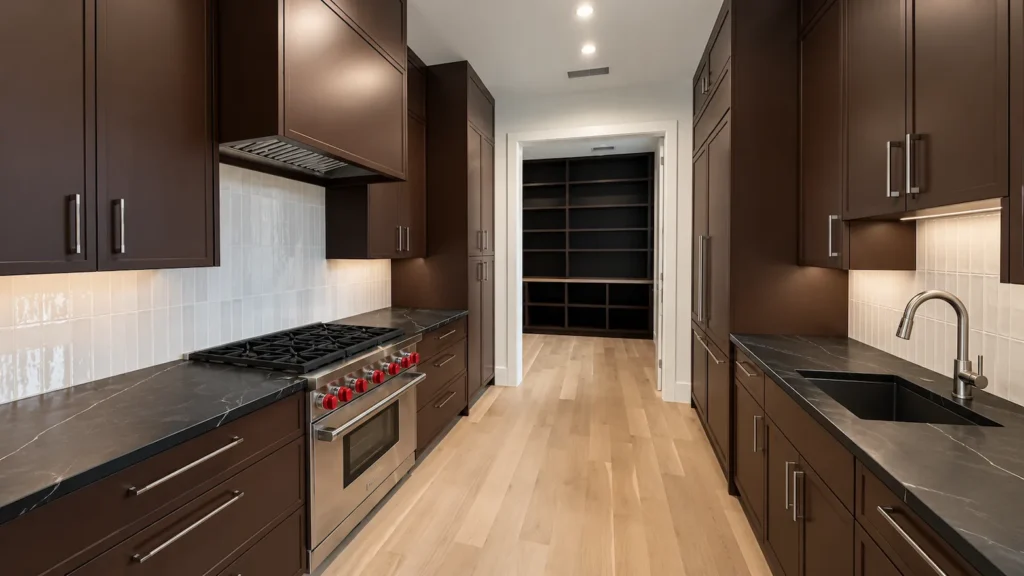
Porcelain countertops cost more than most project managers anticipate the first time they go and budget for them at commercial scale and less expensive than they anticipate the second time around when they actually understand what the figure encompasses.
The slab price in the supplier’s quote is just one element of the total outlay. Fabrication complexity, edge work, cut outs, seam placement, delivery & handling and installation risk are all factors which add to the final figure in a way that isn’t visible on a material invoice but is very much apparent on the project budget when the job is complete.
In a commercial or larger residential renovation where you’re doing several kitchen and/or bathroom countertop installations over the property the gap between the slab price and the installed price gets worse with every surface.
At Lone Star Remodeling & Construction porcelain countertops cost is discussed in terms of the full assembly rather than the slab. The entire installed cost of the project is broken down and priced prior to any countertop allowance being established.
What Drives Porcelain Countertops Cost at Scale
Porcelain at commercial scale is subject to the same variables as a single residential installation, just with those variables acting across every surface in the project. A fabrication detail that costs $150 on a single kitchen countertop will cost $1,500 on a 10 unit project where that same detail is present on every installation.
The first step in establishing a realistic porcelain countertops cost allowance at scale is to understand which of the variables have a disproportionate impact on cost.
Porcelain for countertops is available in slab thicknesses from 6mm up to 20mm with 12mm and 20mm being the most common countertop thicknesses. The thicker the slab the more it will cost per sq ft at the material level and the more precise the fabrication needs to be (particularly when you’re dealing with mitered edges which will expose the full thickness of the slab at the perimeter).
On a large project where the thickness of the countertop is a design specification rather than a cost driver the thickness has to be determined prior to finalising the countertop allowance as once you go from 12mm to 20mm in the middle of the project you’ve changed both the material cost and the scope of the fabrication.
Porcelain Countertops Cost: What the Material Quote Covers
Porcelain countertops cost in the Arlington area market is roughly $8 to $18 per sq ft for standard commercial grade porcelain in matte and textured finishes. Premium large format slabs (book matched, veined, ultra-compact etc) from European manufacturers are in the $20 to $45 per sq ft range and up depending on the product and the supplier’s import costs at the time of order.
Those are the supplier material costs. They don’t include the fabrication shop’s cutting and finishing, the template process, delivery to the job site or installation labour. A porcelain slab countertop at $15/sq ft will generally come in at 55-85/sq ft when you add in fabrication and installation (depending on edge profile, cutout count and site access).
On a commercial job with 500 sq ft of countertop across various areas the difference between a $15 and a $25 per sq ft slab is $5k in material cost. The fabrication and installation costs for those same 500 sq ft are pretty much independent of the slab price as the labour required to template, cut, polish and install the porcelain is a function of the geometry and detail of the surface rather than the retail value of the slab.
That distinction enables the project manager to look at the slab price and the fabrication price as two separate items rather than view the installed cost as a fixed multiple of the material cost.
At Lone Star Remodeling & Construction, porcelain countertops cost are something we always take into consideration for kitchen remodeling.
Porcelain Countertops Costs in Fabrication: Where the Budget Expands
Porcelain countertops cost in fabrication is higher per sq ft than either quartz or granite in the majority of the fabrication shops in the Arlington area. This is due to the inherent properties of the material itself (it’s harder and more brittle than engineered stone) which translates into faster tool wear, a greater risk of chipping when cutting and a much narrower tolerance for error on every cut. All of those factors are baked into the fabrication rate and are not something that can be negotiated on the basis of volume of work like material cost can.
A standard fabrication scope for a porcelain countertop would be templating, cutting the slab to the confirmed dimensions, polishing the exposed edges, cutting the sink or cooktop opening and preparing the surface for installation. The scope for a single kitchen countertop (one undermount sink cutout and an eased edge) is generally in the region of 400-700 for labour and shop cost depending on the fabricator and slab thickness.
Every additional bit of detail beyond the base scope adds to the countertop fabrication cost in a way that compounds very rapidly at scale. A waterfall edge on an island means you’re mitering the slab at 45 degrees on both the horizontal and vertical panels which is a very precise cut and adds $200 to $400 per miter joint depending on slab thickness.
A vessel sink cutout with a finished interior edge takes significantly more time than a standard undermount opening. A faucet hole in a thick format slab is a core drill and has its own per hole cost. On a commercial job with 20 surfaces and a wide variety of detail specifications across them, the only way to get a fabrication cost estimate that will stand up through the fabrication process is to catalogue every detail by surface prior to fabrication.
Porcelain Edge Profiles: Cost Implications by Detail Type
Porcelain edge profiles are the fabrication detail that most directly speaks to the design direction of the installation and the one which has by far the widest cost range in relation to the base fabrication. The profile you see at the edge of the countertop is the outcome of a particular cutting and polishing sequence which in terms of complexity and time taken ranges from the simplest straight eased edge to the most complex ogee or laminated built-up profile.
An ‘eased’ edge (the standard profile for most commercial countertop work) is simply a 45 degree chamfer at the top and bottom edges of the slab. It’s the quickest edge to produce, the cheapest to fabricate and the most consistent in appearance when you’ve got a large number of slabs all meeting together.
On a commercial job where you’re looking for consistency across a multitude of surfaces rather than any particular edge being distinctive, an eased edge on all the horizontal surfaces is a very sensible specification from a cost point of view and will look intentional rather than generic if the slab material is of any interest at all.
A mitered waterfall edge (where the countertop surface goes straight down the side of an island or peninsula) requires the slab to be cut at precisely 45 degrees on both panels and then joined together with a virtually invisible seam at the corner. The cost of a waterfall edge is between $600 and $1,200 per corner depending on slab thickness and the fabricator’s access to the particular porcelain.
Porcelain is harder to miter cleanly than quartz due to its brittleness which increases the chance of a micro-fracture at the miter cut that only shows up when the joint is actually under the stress of installation. Fabricators who work with porcelain at a commercial scale will of course factor that risk into their miter rate.
A pencil edge or full bullnose on a porcelain slab requires radius grinding right across the full length of the edge which is a very time consuming operation and adds $15 to $30 per linear foot to the fabrication cost as opposed to an eased edge. On a large island with 20 linear feet of perimeter edge that’s an additional $300 to $600 for the fabrication of a single surface. Across a ten unit project with that profile specified on every island the edge profile choice adds $3,000 to $6,000 to the total fabrication budget.
Countertop Installation Allowances for Commercial Projects
Countertop installation allowances on commercial and larger residential renovation projects need to account for more variables than a single-family residential allowance does. Site access, building elevator availability, crew size requirements for handling large-format slabs safely, and the coordination sequencing between countertop installation and adjacent trades all affect the installed cost in ways that a per-square-foot material allowance doesn’t capture.
Porcelain slabs in 120×60 inch or 126×63 inch formats weigh between 100 and 200 pounds depending on thickness. Moving those slabs through a commercial building to upper floors, through doorways with limited clearance, or into kitchens with restricted access routes requires specialized handling equipment and crew coordination that adds to the installation cost per surface.
A countertop installation allowance that was built from a single-family residential baseline without adjusting for commercial site conditions consistently underfunds the actual installation scope.
Porcelain breakage during fabrication runs at a higher rate than quartz, and a commercial project that doesn’t carry a slab replacement contingency of 5 to 10 percent of the material cost is carrying an unpriced risk.
Seam Placement and Its Effect on Porcelain Countertops Cost
Seam placement in a porcelain countertop installation is a fabrication and design decision with direct cost implications that are frequently underaddressed in project planning conversations. Porcelain slabs have a maximum format size determined by the manufacturer, typically in the range of 126 by 63 inches. Any countertop run that exceeds those dimensions in either direction requires a seam, and the placement of that seam affects both the visual outcome and the fabrication cost.
A seam placed at a visually logical location, such as at a change of direction in an L-shaped counter run or at the edge of a cooktop cutout, reads as a design detail rather than a limitation. A seam placed mid-surface on a long straight run reads as a material constraint and reduces the perceived quality of the installation regardless of how precisely the seam was executed.
Designing seam placement before the fabrication scope is finalized allows seam cost to be included in the estimate from the start rather than appearing as an additional charge when the template reveals that the counter run exceeds the slab format.
Each seam in a porcelain countertop installation adds approximately $150 to $300 to the fabrication cost for the joining, polishing, and color-matching work required to minimize its visibility. On a project with many long counter runs, the seam count needs to be estimated based on the actual dimensions of each surface and the available slab formats, not assumed to be zero.
Questions to Take Into a Porcelain Countertops Cost Consultation
Before entering a consultation focused on porcelain countertops cost for a commercial or larger-scale project, the questions that generate the most useful information cover the following.
What is the fabrication shop’s experience with porcelain specifically, and what is their breakage rate on large-format porcelain projects? How are countertop fabrication costs itemized: is edge profile, cutout, seam, and delivery priced separately, or bundled into a single per-square-foot installed rate?
What slab replacement contingency is built into the project allowance, and who bears the cost of a slab that breaks during fabrication or installation? How are countertop installation allowances structured across the project: per surface, per unit, or as a project total? What is the lead time from confirmed slab selection to completed installation, and which phase of the construction sequence does countertop installation need to follow?
Reach out to Lone Star Remodeling & Construction for a detailed consultation on porcelain countertops cost and a realistic countertop allowance built around the actual scope of your Arlington project.
FAQ
What is the installed cost for porcelain countertops in Arlington, TX?
Installed porcelain countertops cost in the Arlington area typically runs between $55 and $95 per square foot for standard commercial-grade porcelain with an eased edge, a single sink cutout, and standard site access conditions. Premium large-format slabs with complex edge profiles, multiple cutouts, and waterfall details run between $100 and $160 per square foot installed.
Why is porcelain countertop fabrication more expensive than quartz?
Porcelain is harder and more brittle than quartz, which means cutting tools wear faster, the risk of chipping during precision cuts is higher, and the fabricator’s margin for error on complex details is narrower. Those factors are priced into the fabrication rate as a material handling premium. On thick-format slabs and on mitered waterfall edges, the cost differential between porcelain and quartz fabrication is most pronounced because those are the operations where porcelain’s brittleness creates the greatest fabrication risk.
How do porcelain edge profiles affect the total countertop budget?
Edge profile complexity adds directly to countertop fabrication costs. An eased edge adds minimal cost over the base fabrication scope. A full bullnose or radius profile adds $15 to $30 per linear foot in polishing labor. A mitered waterfall edge adds $600 to $1,200 per corner depending on slab thickness. On a commercial project where the same edge profile is repeated across many surfaces, the profile selection multiplies by the total linear footage across the project and needs to be confirmed before fabrication costs are estimated.
What should a countertop installation allowance include for a commercial project?
A complete countertop installation allowance for a commercial porcelain countertops cost budget includes templating labor, fabrication cost itemized by edge profile and cutout type for each surface, slab delivery adjusted for site access conditions, installation labor per surface, and a slab breakage contingency of 5 to 10 percent of the total material cost. Allowances built from a single per-square-foot installed rate without separating those components consistently underfund the actual scope on larger projects.
How are seams priced in a porcelain countertop installation?
Each seam in a porcelain countertop installation adds approximately $150 to $300 to the fabrication cost for joining, polishing, and color-matching work. Seam count on a project should be estimated based on the actual dimensions of each counter run against the available slab formats, not assumed to be zero. Strategic seam placement at changes of direction or at fixture cutouts reduces the visual impact of required seams and is a design decision that belongs in the planning conversation before fabrication begins.